Tell us about the job
Takes about a minute. No obligation.
Gas water heater replacement in Wayne County starts with what is already in the walls. Utility gas heats more occupied homes in Wayne County, New York than any other fuel, at 53.6% (2020-2024 ACS 5-year). That share means most homes here have a gas flue somewhere, but its condition, diameter, and path through the structure decide whether a new unit can use it or whether the contractor has to run new venting. Combustion air supply is the other variable: a tightly built or remodeled space draws differently than the original install assumed, and a contractor checks both before settling on a unit size or configuration.
Existing electrical service is what decides how a water heater installation goes in much of Wayne County. Half the homes in Wayne County, New York were built in 1968 or earlier (2020-2024 ACS 5-year). That means the panels and circuits already in the house were put in for equipment that drew far less than what runs today, and a contractor pricing a new unit has to look at what the service can actually carry before the appliance itself becomes the question. A panel that falls short changes the scope and the bill.
What a Water Heater Installation Puts in Your Home
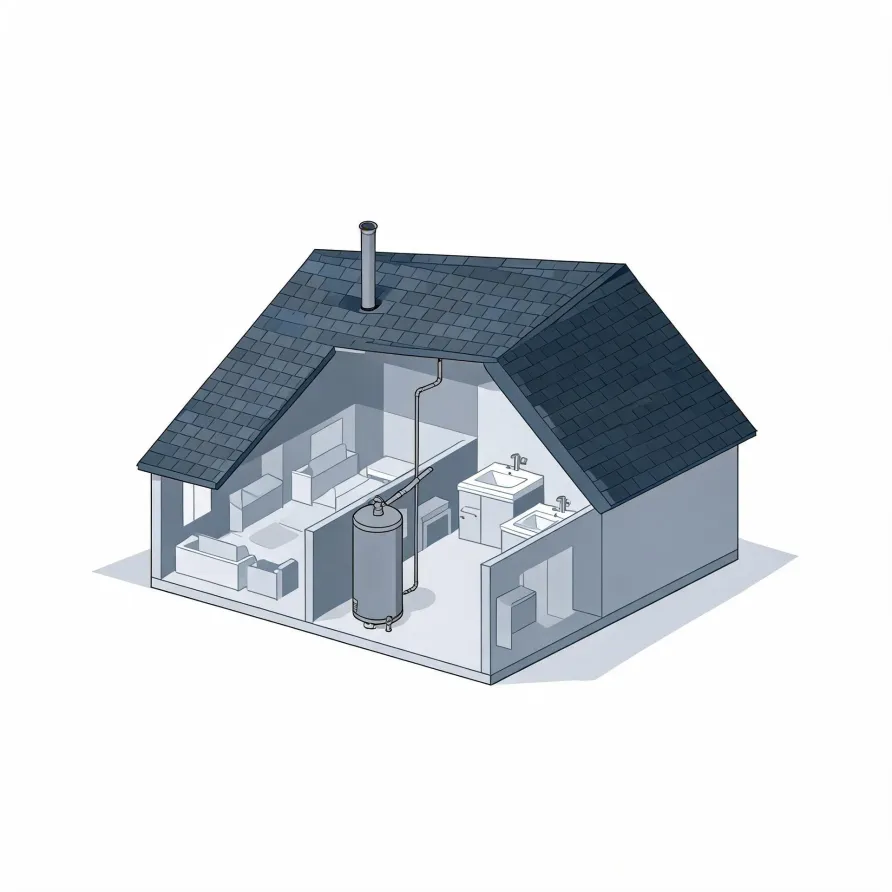
The tank is the piece most homeowners recognize first. It sits in a utility room, basement, or closet and holds a supply of water that a burner or heating element keeps at temperature. The pressure relief valve mounts directly on the tank and releases if pressure inside climbs too high.
A cold water inlet line feeds the tank from the main supply, and a hot water outlet line carries heated water out to the rest of the house. The anode rod hangs inside the tank and slows corrosion of the tank walls. A drain valve at the base lets a contractor access the interior when the work calls for it.
The drawing shows a representative layout, and a licensed contractor determines what the installation requires for your specific house and setup.
Get matched in Wayne CountyWayne County, by the numbers
129 severe weather events were recorded in Wayne County, New York between 2015 and 2024.
NOAA National Centers for Environmental Information, Storm Events Database, bulk CSV export, events 2015-01-01 through 2024-12-31.Half the homes in Wayne County, New York were built in 1968 or earlier (2020-2024 ACS 5-year).
U.S. Census Bureau, 2020-2024 American Community Survey 5-Year EstimatesWayne County, New York holds 42,570 housing units (2020-2024 ACS 5-year).
U.S. Census Bureau, 2020-2024 American Community Survey 5-Year EstimatesOwners occupy 79.9% of the occupied homes in Wayne County, New York (2020-2024 ACS 5-year).
U.S. Census Bureau, 2020-2024 American Community Survey 5-Year EstimatesSevere Weather Events in Wayne County
Water heaters work harder when outdoor conditions swing hard, and Wayne County's weather record shapes how much demand a unit faces over its life. That workload is a local fact, and it bears on what gets installed here.
129 severe weather events, 2015–2024. Source: NOAA National Centers for Environmental Information, Storm Events Database.