Tell us about the job
Takes about a minute. No obligation.
Gas-fired water heaters run every day, all year, regardless of season. Utility gas heats more occupied homes in Erie County, New York than any other fuel, at 86.8% (2020-2024 ACS 5-year). That concentration means the overwhelming majority of water heaters in this county share the same combustion components: a gas valve, a burner assembly, a thermocouple or thermopile, and a flue. When one fails, a contractor checks the ignition system and the gas valve first, because those parts cycle with every heating demand, accumulating wear across years of daily use. A failed thermocouple is a far more common finding here than a failed electric heating element, simply because electric water heaters are rare in this market.
Postwar construction in Erie County left behind plumbing and venting arrangements built around equipment long since replaced, and a water heater repair job here can turn on what surrounds the unit as much as the unit itself. Half the homes in Erie County, New York were built in 1957 or earlier (2020-2024 ACS 5-year). A contractor opening a water heater in a house that old may find venting that was adapted more than once, supply line configurations that do not match current fittings, or pressure relief routing that was never updated. Those surrounding conditions decide whether a repair stays simple or expands the moment work begins.
The Parts of a Water Heater a Contractor Checks First
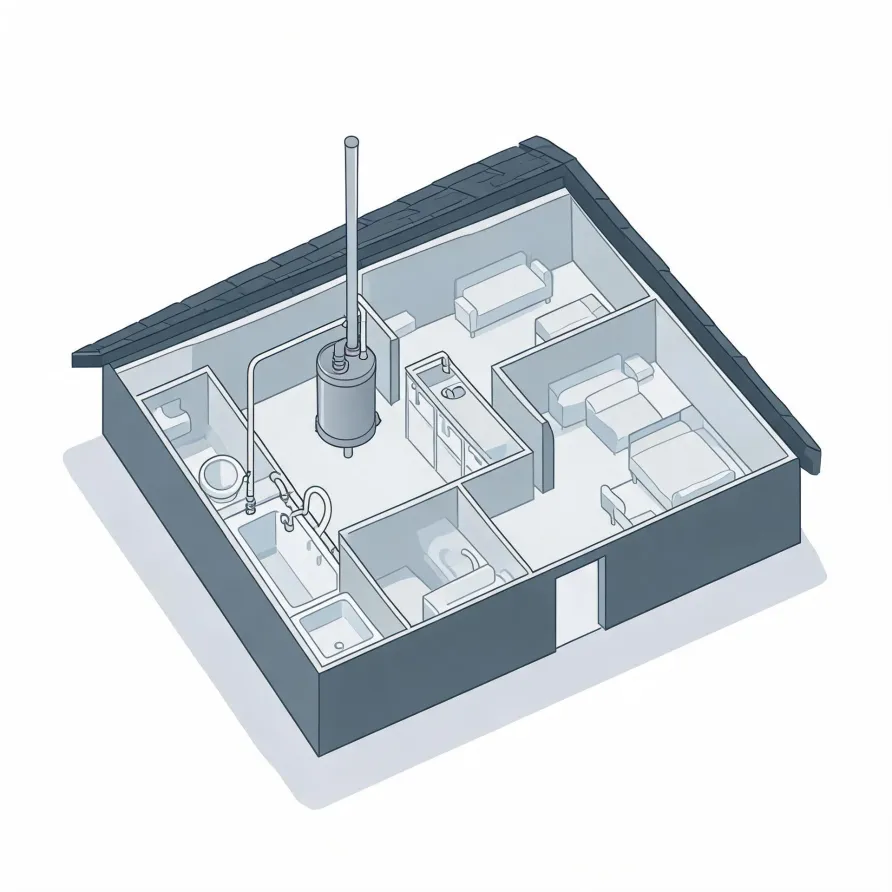
The tank is what most homeowners picture first: a large insulated cylinder that sits in a basement, utility closet, or garage and holds a ready supply of hot water. Inside it, either a burner assembly at the base or electric heating elements mounted through the tank wall do the actual heating. When a unit stops producing hot water or produces it inconsistently, those heating components and the thermostat that controls them are where a contractor starts.
The pressure relief valve mounts on the side of the tank and opens automatically if pressure or temperature climbs past a safe point. A drain valve sits near the bottom. Connecting the tank to the rest of the house are cold and hot water supply lines at the top, and on gas units, a flue pipe carries combustion exhaust out of the building.
The drawing shows the general layout of a water heater and its components, and a licensed contractor determines exactly what applies to the unit in your home.
Get matched in Erie CountyErie County, by the numbers
329 severe weather events were recorded in Erie County, New York between 2015 and 2024.
NOAA National Centers for Environmental Information, Storm Events Database, bulk CSV export, events 2015-01-01 through 2024-12-31.Half the homes in Erie County, New York were built in 1957 or earlier (2020-2024 ACS 5-year).
U.S. Census Bureau, 2020-2024 American Community Survey 5-Year EstimatesErie County, New York holds 441,214 housing units (2020-2024 ACS 5-year).
U.S. Census Bureau, 2020-2024 American Community Survey 5-Year EstimatesOwners occupy 65.8% of the occupied homes in Erie County, New York (2020-2024 ACS 5-year).
U.S. Census Bureau, 2020-2024 American Community Survey 5-Year EstimatesSevere Weather Events in Erie County
Water heaters work harder when outside conditions swing hard, and Erie County's weather puts real load on equipment over time. How often that happens here shapes how quickly wear builds and when a repair call becomes necessary.
329 severe weather events, 2015–2024. Source: NOAA National Centers for Environmental Information, Storm Events Database.